

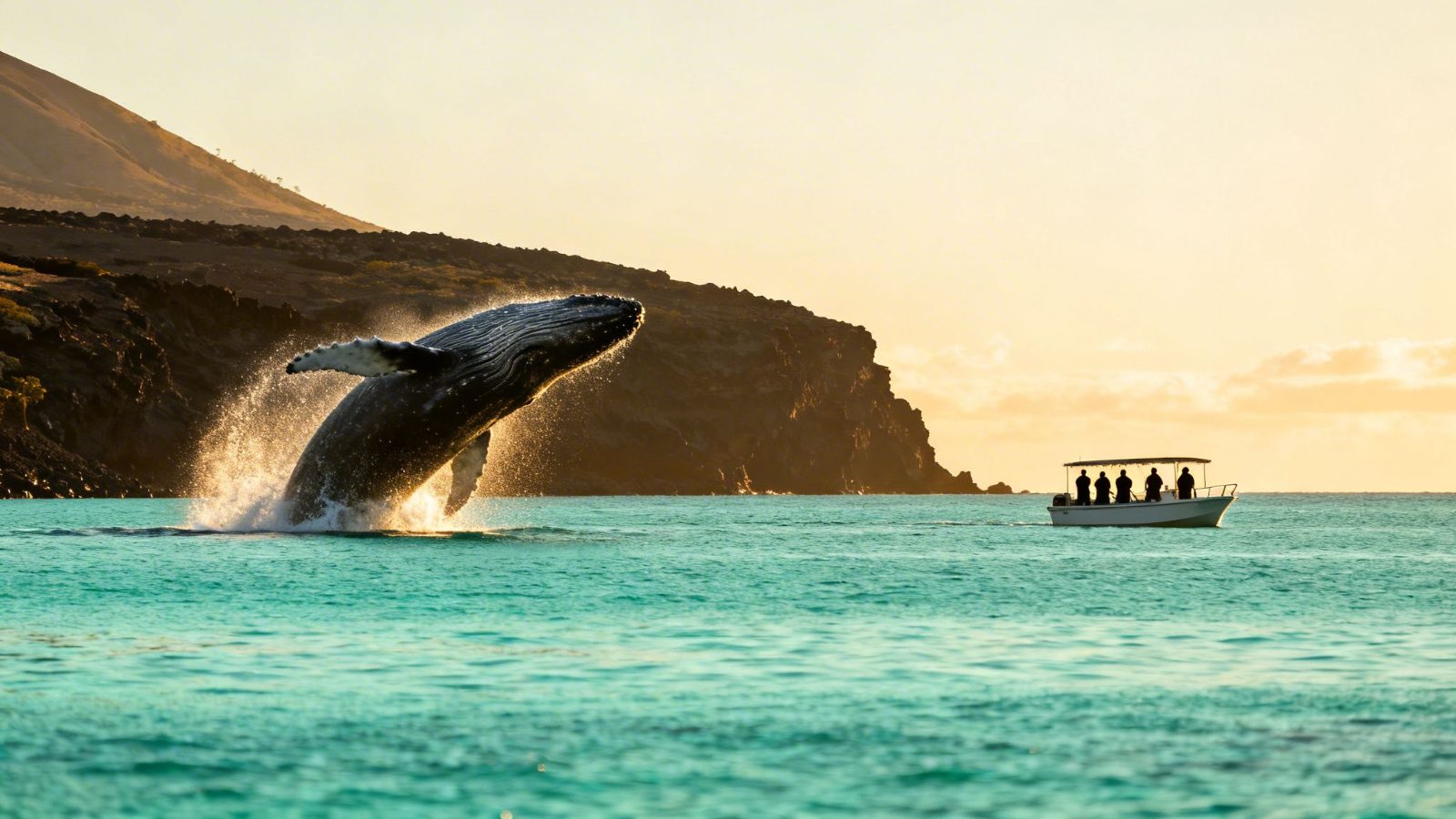
Quick answer
Yes, you can see whales in Kona from December through April, with peak activity occurring between January and March. Humpback whales migrate to Hawaiian waters during these months to breed and calve in the warm, protected bays along the Kona coast. Morning hours between 7:00 AM and noon offer the highest whale activity and calmest ocean conditions for viewing from public shorelines or charter boats.
Every year, roughly two-thirds of the North Pacific humpback whale population—about 10,000 individuals—migrate to Hawaiian waters, and the Kona coast receives a significant portion of that traffic. The whales begin arriving in late November, with numbers building through December as mature adults and pregnant females make the 3,000-mile journey from Alaska. By mid-January, calves born in Hawaiian waters join the surface activity, and the combination of breeding behavior, nursing mothers, and competitive male groups creates the densest concentration of observable whale activity. Kona whale watching differs from other Hawaiian islands due to the steep offshore drop and deep-water proximity. The ocean floor descends rapidly just a few hundred yards from shore, allowing humpbacks to approach closer to land than in shallower regions. This bathymetry means that land-based observers along Alii Drive, at Keauhou Bay, or near the Kona airport often spot whales without leaving the shoreline. The same topography also explains why charter boats reach prime viewing zones within 10 to 15 minutes of departure—the whales are already there. Migration patterns follow a predictable arc. December marks the start, with sightings scattered and whales still in transit. January through March represents the peak window, when breeding activity, mother-calf pairs, and competitive pods overlap. April signals the beginning of the return migration, as whales begin the journey back to Alaskan feeding grounds. By early May, sightings drop sharply, and the season effectively closes until the following winter. Understanding this cycle answers the question of whether you can see whales in Kona—and clarifies that timing matters more than location. The North Pacific humpback whale population was listed as endangered until 2016, when decades of protection under the Marine Mammal Protection Act allowed numbers to recover. Today, the population is monitored but no longer classified as endangered, and the annual migration to Kona remains one of the most reliable wildlife events in the Hawaiian Islands. Federal law requires all vessels and swimmers to maintain a 100-yard distance from whales, a regulation enforced by NOAA and the Hawaiian Islands Humpback Whale National Marine Sanctuary, which includes waters off the Kona coast. These protections ensure that the migration corridor remains viable and that whale watching in Kona continues as both an ecological phenomenon and a visitor experience.
“The ocean floor descends rapidly just a few hundred yards from shore, allowing humpbacks to approach closer to land than in shallower regions.”
When Can You See Whales In Kona: Peak Months and Migration
The North Pacific Humpback whale migration season in Kailua-Kona typically spans from December through April. Peak viewing occurs during the height of the season, specifically in February and March, when whale activity is most frequent.
December
Moderate75-80°F, occasional rain
Arrival of the first migrating humpbacks from Alaska begins.
January
High75-80°F, consistent breezes
Whale sightings become more frequent across Kona coastal waters.
February-March
Very High76-81°F, mostly sunny
These months represent the peak of the migration and activity.
April
Moderate77-82°F, warm and dry
Whale sightings decrease as the population begins the northern migration.
Verdict: The best time to see whales in Kailua-Kona is during February or March.
Daily Hours To Maximize When Can You See Whales In Kona
Observation opportunities in Kailua-Kona are available daily. Planning your visit during the designated morning arrival window helps ensure better sightings.
| Monday | 00:00–23:59 | |
|---|---|---|
| Tuesday | 00:00–23:59 | |
| Wednesday | 00:00–23:59 | |
| Thursday | 00:00–23:59 | |
| Friday | 00:00–23:59 | |
| Saturday | 00:00–23:59 | |
| Sunday | 00:00–23:59 |
Costs and Fees: Can You See Whales In Kona For Free?
Costs for whale watching in Kailua-Kona depend on whether you choose to observe from the public shoreline or participate in a commercial boat excursion. Shoreline viewing is accessible at no cost, while organized tours set their own independent pricing.
Public shoreline viewing is 0 USD, while total costs for boat excursions vary based on the selected tour operator.
Behavioral Facts: Can You See Whales In Kona And What To Expect
Humpback whales display various surface behaviors in the waters off Kailua-Kona during their annual residency. These actions serve functions ranging from communication to mating displays.
Breaching involves powerful leaps
Whales propel up to 40 percent of their body mass out of the water, landing with a significant splash to communicate or dislodge parasites.
Tail slapping creates acoustic signals
Whales strike the surface of the water with their flukes, producing loud sounds that can be heard over long distances to signal other whales.
Pectoral slapping signals social interaction
Using their long fins, whales strike the water surface repeatedly, a behavior often associated with mating displays or social bonding within a pod.
Spyhopping allows vertical observation
Whales position themselves vertically in the water to bring their heads above the surface, enabling them to observe activities occurring above the waterline.
Peduncle throws demonstrate physical strength
This aggressive or social behavior involves a whale thrusting its tail and the rear portion of its body sideways or backward out of the water.
Competitive pods display group dynamics
Multiple males often follow a single female, engaging in high-energy maneuvers and complex social interactions while competing for proximity to the female.
Checklist For Preparing When Can You See Whales In Kona
Prepare for whale watching from shore or boat with these essentials.
-
Book a boat tour if desired — Tours offer closer encounters and expert commentary on humpback behavior.
-
Bring binoculars for shoreline viewing — Whales surface 200-500 yards offshore; magnification reveals breaches and tail slaps.
-
Pack seasickness medication for boat trips — Ocean swells can be significant even on calm days during whale season.
-
Wear sun protection and a hat — Morning sun reflects intensely off water with minimal shade available.
-
Arrive between 7:00-12:00 — Whale activity peaks in morning hours when waters are calmest.
-
Carry water and light snacks — Shore viewing sessions often extend beyond planned time when whales are active.
Check availability
Frequently asked questions about can you see whales in kona
Everything you need to know about can you see whales in kona